SAGE: Adaptive Recommendation of Spreadsheet Pivot Tables
Diagram
Summary
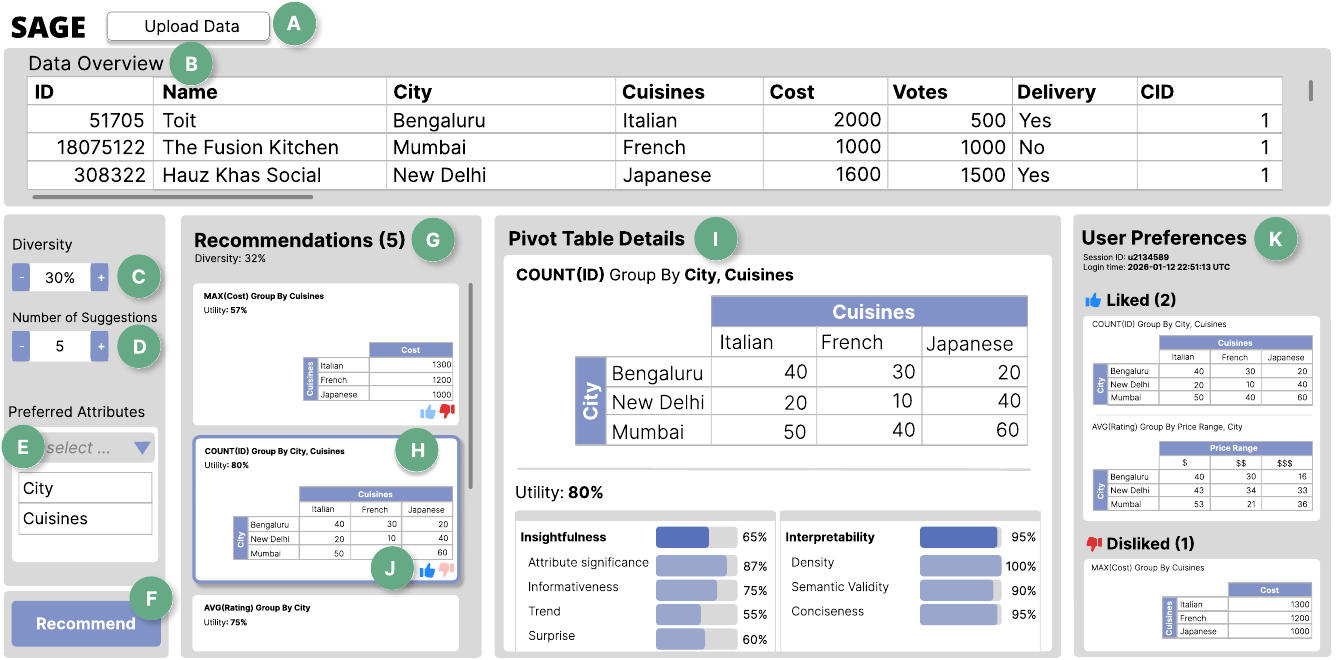
Recommends diverse, interpretable pivot tables using data semantics and an optimized greedy algorithm. Users steer recommendations through attribute preferences, diversity controls, and feedback.
Citation / BibTeX
Whanhee Cho, Shamit Fatin, and Anna Fariha. 2026. SAGE: Adaptive Recommendation of Spreadsheet Pivot Tables. Companion of the International Conference on Management of Data (SIGMOD Companion ’26), 22–25. Association for Computing Machinery. https://doi.org/10.1145/3788853.3801579
@inproceedings{10.1145/3788853.3801579,
author = {Cho, Whanhee and Fatin, Shamit and Fariha, Anna},
title = {SAGE: Adaptive Recommendation of Spreadsheet Pivot Tables},
year = {2026},
isbn = {9798400724503},
publisher = {Association for Computing Machinery},
address = {New York, NY, USA},
url = {https://doi.org/10.1145/3788853.3801579},
doi = {10.1145/3788853.3801579},
abstract = {Spreadsheet data is ubiquitous, with billions of users relying on spreadsheets for everyday tasks such as financial analysis and decision making. To make sense of spreadsheet datasets and extract data insights, users rely on data summaries. Pivot tables enable summarization through aggregation—such as SUM or MEAN—over a few data attributes, grouped by other attributes. Nevertheless, manually searching for interesting pivot tables is tedious—especially for high-dimensional datasets—prompting commercial spreadsheet software to offer pivot table recommendations. However, existing approaches often provide poor-quality recommendations that are redundant, semantically uninteresting, and difficult to interpret. Further, they typically lack adaptiveness and customizability, offering little to no control to the user. We demonstrate SAGE—a data-semantics-aware system for recommending a diverse set of insightful and interpretable pivot tables. Under the hood, SAGE relies on (1) a novel data-semantics-aware model to quantify the utility of individual pivot tables and the diversity of a set of pivot tables, and (2) a scalable greedy algorithm that efficiently selects a set of high-utility, diverse pivot tables. Beyond improving the overall quality of the recommended pivot table set compared to existing approaches, SAGE offers two additional features: (1) it adapts based on user feedback, allowing users to provide positive or negative signals to steer recommendations toward their goals, and (2) it provides enhanced control, enabling users to specify preferences such as the number of recommendations, attributes of interest, and the desired degree of diversity.},
booktitle = {Companion of the International Conference on Management of Data},
pages = {22–25},
numpages = {4},
keywords = {pivot tables, data semantics, diversification},
location = {Bengaluru, India},
series = {SIGMOD Companion '26}
}